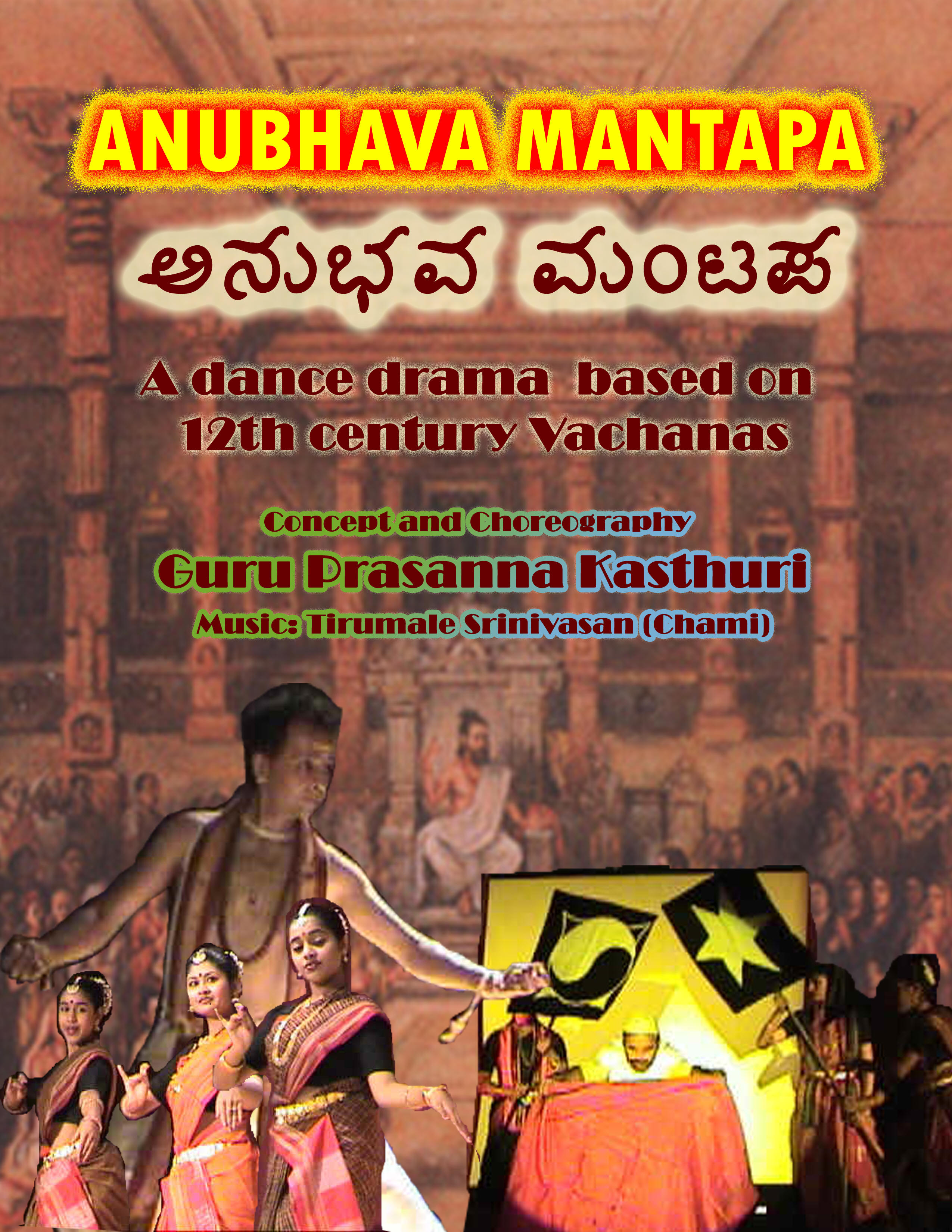
Anubhava Mantapa


Life is undefinable, if one thinks he can draw the limits and boundaries. Human thinking to attain that utopian peace and eternal happiness is unrivalled. Thinkers thought and taught those silver lightning principles to cross the dark clouds of provocative thoughts. As the juice of a plant, fragrance of a flower, ferocity of an ocean wave, the mortal life is stuck around the spiritual energy. Great sharanas portrayed this truth through their immortal vachanas which are relevant to all the time. Anubhava Mantapa, the hall of experience where great sharanas met and discussed and found the principle of eternal happiness, will be inspiring every one of us. Each true sharana’s life is an Anubhava Mantapa.

Soorya Dance Company of St. Louis, Missouri, is making a brave attempt to build the bridge between ancient thoughts from vachanas to present life situations with a sattire. With a fickle human mind the basic instincts remains ever challenging. Vachanas shed the light of knowledge to attain a fulfilled life.


The Dance Details.


Samsaara

Material world is locking the soul and mind. Body is running behind pleasure. Although most of the world is suffering, the body still needs the pleasure

Bhaktha Sthala

World is full of conflicts. People with closed minds are searching for god in temples, mosques and churches and fighting for land. Rivers are not bound by lands, oceans are not bound by lands, a sharana has no boundary for his worship.

Nisarga

Nature waits for no one. It is gods creation. His omnipresence makes the cycle of life run smoothly. Wise sharana vachanas discover the immense truth of co-existance of nature and man.

.

Shoonya sampadane

Stop the illusion at the doorstep of life, stop the physical attractions at the door steps of soul, stop the mind athe doorstep of god. Understand the senses for other limbs. Understand the soul, mind, god and rise alert to reach almighty Koodala Sangama. The unknown which science is trying to explore in the galaxies starts with in our minds.

Agnana mattu Maaye

Illusion shadows body. Mind shadows the life. Memory shadows mind. The complete civilization followed the illusion – Maaye will never achieve bliss of grace of almighty. Performing penance in the forest will not get rid of dark shadow of ignorance. Agnana(ignorance) and maaye(illusion) runs the mind behind acquiring material wealth in immoral and unethical ways.


Ananda Sharana

A happy Sharana stays away from praise, faces criticism stands firm.
Makes a difference between visible and invisibles. The truthful, pious sharana is an eternal happy person.
All the vachanas used in this production are from Basavanna, Allama Prabhu, Ambigara Chowdiaha and many others.


Credits

No. of Artists: 13 dancers
Duration: 45 minutes
Music: Chami - Tirumale Srinivasan
Lighting: Bhagavan Doss
Special Guest Artists: K.R.V. Pulikeshi, Sushma Mohan (Bangalore, India)
Direction & Choreography: Prasanna Kasthuri
Production: By Soorya Dance Company

Music Director

The music direction for Anubhava Mantapa is by Tirumale Srinivasan (popularly known as Chami ). Chami is the elder son of Tirumale SriRangachar, who is the leading proponent of Kannada style of performing arts. Chami obtained carnatic music training from many great teachers. Chami has scored music to more than 200 cassettes and his compositions to bharathanatyam are very popular. For Soorya Dance Company he has scored music for Anubhava Mantapa, Jnana, Shrungara Nayakaru. He also has scored music to other well known dancers such as Nirupama & Rajendra, Maya Rao and others.

Back to Top

Dance Director

Guru Prasanna Kasthuri has choreographed Anubhava Mantapa by thorough research on the Sharana Sahitya. He was able assisted by Sri. Pulikeshi Kasthuri and Smt. Sushma Mohan. The concept and imagination of Guru Kasthuri came out into a full appreciation in the Veerashaiva Sammelana in Columbus, Ohio. The presentation of dance drama "Anubhava Mantapa" proved the everlasting truth of vachanas of great sharanas .


Back to Top

Basavanna and Veerashaivism

Veera Shaivism

Veera Shaivism is one of the most dynamic of modern-day Shaivite schools. It was made popular by the remarkable South Indian brahmin Shri Basavanna (1105-1167). Adherents trace the roots of their faith back to the rishis of ancient times. Veera, "heroic," Shaivites are also known as Lingayats, "bearers of the Linga." All members are to constantly wear a Linga encased in a pendant around the neck. Of this practice, Thavathiru Shantalinga Ramasamy of Coimbatore recently said, "I can say that Veera Shaiva worship is the best form of worship because Sivalinga is worn on our body and it unites the soul with the Omnipresence. We are always in touch with Lord Siva, without even a few seconds break." Followers are also called Lingavantas and Sivasharanas.

Like the sixteenth-century Protestant revolt against Catholic authority, the Lingayat movement championed the cause of the down-trodden, rebelling against a powerful brahminical system which promoted social inequality through a caste system that branded a whole class of people (harijans) as polluted. Going against the way of the times, the Lingayats rejected, Vedic authority, caste hierarchy, the system of four ashramas, a multiplicity of Gods, ritualistic (and self-aggrandizing) priestcraft, animal sacrifice, karmic bondage, the existence of inner worlds, duality of God and soul, temple worship and the traditions of ritual purity-pollution.

Veera Shaiva tradition states that Basavanna was a reflective and defiant youth who rejected much of the Shaivism practiced in his day, tore off his sacred thread, yajnopavita, at age 16 and fled to Sangama, Karnataka. He received shelter and encouragement from Ishanya Guru, a Shaivite brahmin of the prevailing Kalamukha sect, and studied under him at his monastery-temple complex for twelve years. There he developed a profound devotion to Siva as Lord Kudalasangama, "Lord of the meeting rivers." At age 28, Basavanna arrived at the insight that the brotherhood of man rests on the doctrine of a personalized, individual Godhood in the form of Ishtalinga ("chosen, or personal Linga"). This spiritual realization gave rise to the central Veera Shaiva belief that the human body is to be revered as a moving temple of the Lord, to be kept in a perpetual state of purity and sublimity.

Near the completion of his studies at Sangama, Basavanna had a vivid dream in which the Lord Kudalasangama touched his body gently, saying, "Basavanna, my son, the time has come at last for your departure from this place. There is Bijjala in Mangalavede. Carry on your work of building a just society from there." Having received these inner orders, he journeyed to Mangalavede and sought service in the court of Bijjala. He rose to become chief officer of the royal treasury, minister to this maharaja in his troubled Shaivite country at odds with Buddhism and Jainism. This position led to the swift spreading of Basavanna's revolutionary message of a new, visionary religious society.

Basavanna wedded two wives, taking on the householder dharma, strengthening his teaching that all followers-not only renunciates-can live a holy life. He gave discourses each evening, denouncing caste hierarchy, magical practices, astrology, temple building and more, urging growing crowds of listeners to think rationally and worship Siva as the God within themselves. Here Basavanna lived and preached for twenty years, developing a large Shaivite religious movement. The function of gathering for discourse became known as Sivanubhava Mandapa, "hall of Siva experience."

At age 48 he moved with King Bijjala to Kalyana, where, joined by Allama Prabhu, his fame continued to grow for the next fourteen years. Devotees of every walk of life flocked from all over India to join with him. Through the years, opposition to his egalitarian community grew strong among more conventional citizens. Tensions came to a head in 1167 when a brahmin and shudra, both Lingayats, married. Outraged citizens appealed to King Bijjala, who took ruthless action and executed them both. The unstable political situation further disintegrated, and the King was shortly thereafter murdered by political opponents or possibly by Lingayat radicals. Riots erupted and the Lingayats were scattered far and wide. Basavanna, feeling his mission in the capital had come to an end, left for Sangama, and shortly thereafter died, at the age of 62. Leaders and followers transferred the institutional resources created in the urban Kalyana to the rural villages of Karnataka.

In spite of persecution, successful spiritual leadership left a legacy of sainthood, including many women saints. If Basavanna was the faith's intellectual and social architect, Allama Prabhu was its austerely mystical powerhouse. The doctrines of these two founders are contained in their Vachanas, or prose lyrics. Veera Shaiva spiritual authority derives from the life and writings of these two knowers of Siva and of numerous other Sivasharanas, "those surrendered to God." Roughly 450 writers of these scriptures have been identified. The Vachanas, "what is said," scorn the Vedas, mock ritual, and reject the legends of Gods and Goddesses. The authors of these verses saw formal religions as the "establishment," static institutions that promise man security and predictability, whereas they knew that religion must be dynamic, spontaneous, freed of bargains extracted in exchange for salvation. These scriptures reject "doing good" so one may go to heaven. Allama wrote, "Feed the poor, tell the truth, make water places for the thirsty and build tanks for a town. You may go to heaven after death, but you'll be nowhere near the truth of our Lord. And the man who knows our Lord, he gets no results." The Vachanas are incandescent poetry, full of humor, ridicule and the white heat of Truth-seeking, bristling with monotheism, commanding devotees to enter the awesome realm of personal spirituality.

These poems, written in the Kannada language, are central in the religious life of Lingayats. Here are some samples. Ganachara wrote, "They say I have been born, but I have no birth, Lord! They say I have died, but I have no death, O Lord!" Basavanna exclaimed, "Lord, the brahmin priest does not act as he speaks. How is that? He goes one way, while the official code goes the other!" Allama Prabhu said, "Then, when there was neither beginning nor nonbeginning, when there was no conceit or arrogance, when there was neither peace nor peacelessness, when there was neither nothingness nor nonnothingness, when everything remained uncreated and raw, you, Guheshvara, were alone, all by yourself, present yet absent."

Ironically, in the centuries following these days of reform, Veera Shaivism gradually reabsorbed much of what Basavanna had rejected. Thus emerged temple worship, certain traditions of ritual purity, giving gifts to gurus, and the stratification of society, headed up by two large hierarchical orders of jangamas-resulting in the institutionalization of the crucial guru-disciple relationship, which by Veera Shaiva precept should be very personal. Efforts were made to derive Veera Shaiva theology from traditional Hindu scriptures such as Agamas and Sutras-a need rejected by the early sharanas. To this day, by rejecting the Vedas, Lingayats continue to put themselves outside the fold of mainstream Hinduism, but in their acceptance of certain Shaiva Agamas, align themselves with the other Shaiva sects. Veera Shaivites generally regard their faith as a distinct and independent religion.

The original ideals, however, remain embedded in Lingayat scripture, which is of three types: 1) the Vachanas, 2) historical narratives and biographies in verse and 3) specialized works on doctrine and theology. Among the most central texts are Basavanna's Vachanas, Allama Prabhu's Mantra Gopya, Chennabasavanna's Karana Hasuge, and the collected work called Shunya Sampadane.

The monistic-theistic doctrine of Veera Shaivism is called Shakti Vishishtadvaita-a version of qualified nondualism which accepts both difference and nondifference between soul and God, like rays are to the sun. In brief, Siva and the cosmic force, or existence, are one ("Siva are you; you shall return to Siva"). Yet, Siva is beyond His creation, which is real, not illusory. God is both efficient and material cause. The soul in its liberated state attains undifferentiated union with Siva. The Veera Shaiva saint Renukacharya said, "Like water placed in water, fire in fire, the soul that becomes mingled in the Supreme Brahman is not seen as distinct."

True union and identity of Siva (Linga) and soul (anga) is life's goal, described as shunya, or nothingness, which is not an empty void. One merges with Siva by shatsthala, a progressive six-stage path of devotion and surrender: bhakti (devotion), mahesha (selfless service), prasada (earnestly seeking Siva's grace), pranalinga (experience of all as Siva), sharana (egoless refuge in Siva), and aikya (oneness with Siva). Each phase brings the seeker closer, until soul and God are fused in a final state of perpetual Siva consciousness, as rivers merging in the ocean.

Veera Shaivism's means of attainment depends on the panchachara (five codes of conduct) and ashtavarana (eight shields) to protect the body as the abode of the Lord. The five codes are Lingachara (daily worship of the Sivalinga), sadachara (attention to vocation and duty), Sivachara (acknowledging Siva as the one God and equality among members), bhrityachara (humility towards all creatures) and ganachara (defense of the community and its tenets).

The eight shields are guru, Linga, jangama (wandering monk), paduka (water from bathing the Linga or guru's feet), prasada (sacred offering), vibhuti (holy ash), rudraksha (holy beads) and mantra (Namah Sivaya). One enters the Veera Shaiva religion through formal initiation called Linga Diksha, a rite for both boys and girls which replaces the sacred thread ceremony and enjoins the devotee to worship the personal Sivalinga daily. Lingayats place great emphasis on this life, on equality of all members (regardless of caste, education, sex, etc.), on intense social involvement and service to the community. Their faith stresses free will, affirms a purposeful world and avows a pure monotheism.

Today Veera Shaivism is a vibrant faith, particularly strong in its religious homeland of Karnataka, South-Central India. Roughly forty millionpeople live here, of which perhaps 25% are members of the Veera Shaiva religion. There is hardly a village in the state without a jangama and a matha (monastery). On the occasion of birth in a Lingayat family, the child is entered into the faith that same day by a visiting jangama, who bestows a small Sivalinga encased in a pendant tied to a thread. This same Linga is to be worn throughout life.

(Courtesy: http://members.tripod.com/~lingayat/veerashaiva.html)

Back to Top

Prasanna Kasthuri
Copyright © 2003 [Soorya Dance Company]. All rights reserved.